
Anyone can buy clothes, gadgets, groceries, and even furniture with just a few clicks. But have you ever thought about how online stores get your attention in the first place? For online store owners, ecommerce advertising is crucial for getting noticed in a crowded marketplace and converting clicks into actual sales, other than creating a buzz. This guide will explain the basics in simple terms, showing beginners how advertising for ecommerce works and why it is important.
Ecommerce advertising involves paying a specific amount for your store or products to appear online in front of potential customers who may be interested in purchasing them. Instead of waiting for people to find your website by chance, advertising guarantees that your products appear wherever your target audience is already spending time, such as on Google, Facebook, Instagram, TikTok, Amazon, and more.
It's like opening a store, but not just on a quiet street. You also put up signs on the busiest highways where people are most likely to see them. Ecommerce advertising is more flexible than ads in print or on TV. You can set budgets, keep track of clicks, and change your strategy on the fly.
Online stores can reach the right people more easily with ecommerce ads. It has simple but powerful benefits that help new businesses grow more quickly. Some key benefits are:
Online stores have several advantages over traditional ones when they use ecommerce advertising, as it combines visibility, targeting, and results that can be measured. If you do it right, it stands out and turns people who are just looking into loyal customers.
Advertising an ecommerce store may feel overwhelming at first. It is easier to understand and helps beginners focus on what is most important when the process is broken down into simple steps. A good PPC strategy for ecommerce can help you set priorities and reach the right people from the start.
Online stores can achieve successful advertising by following these steps. Starting small and making changes over time can help simple campaigns grow steadily.
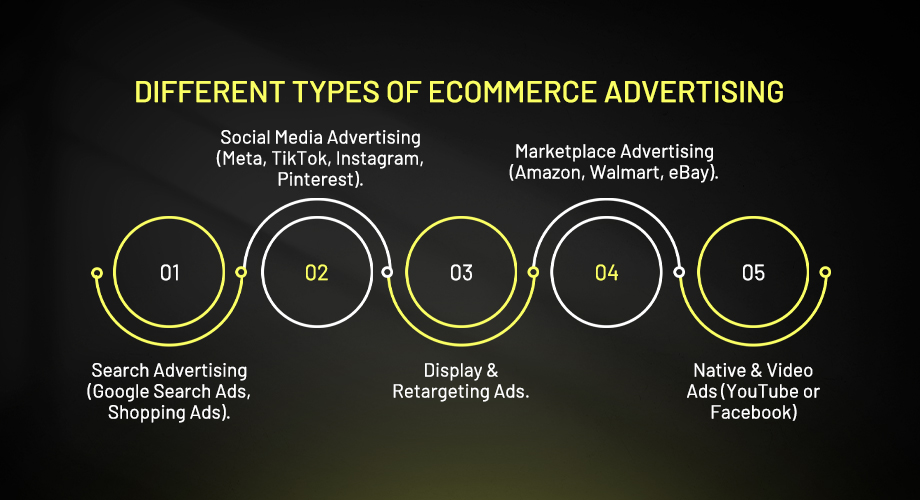
Different types of ecommerce advertising platforms are available, each with its own goal. Online stores can choose the most suitable way to market their products. By doing so, they can reach their target audience and meet their marketing goals once they know what their options are.
When people actively search for specific services, search advertising helps them find the brands that provide the closest match to what they want. For instance, if someone types “wireless earbuds” into Google, ads may appear at the top of the search results..
For people who browse the web daily, social media sites are essential for staying informed about the latest updates on specific topics. You can see ads on platforms like:
Businesses benefit from these platforms in many ways to reach their target audience, making social media advertising an effective practice for driving engagement.
Display ads are pictures or banners that show up on websites to get people's attention. Retargeting ads, on the other hand, follow people who have already been to your site. This keeps your brand in people's minds and makes them more likely to come back and buy something. Retargeting is a great way to get people to finish their purchases.
Marketplace ads help sellers on sites like Walmart and eBay get their products to show up higher in search results and on the pages of their competitors' products. These ads are aimed at people who are already ready to buy, which makes it more likely that they will buy right away. You can also measure them, which lets you improve campaigns in real time on different ecommerce advertising platforms.
Native ads blend in with the content of a website and don't look like annoying banners. Video ads on sites like YouTube or Facebook enable brands to tell stories and demonstrate how products work. Such an ad placement helps people imagine how they can benefit from them. The videos are mechanisms for keeping people engaged, increasing brand awareness, and building trust over time.
With so many advertising platforms available, it can be challenging to decide where to allocate your budget. What you sell and where your target customers spend their time will help you choose the best platform.
Online stores can optimize their ads by matching the platform to the product and the target audience. Start small but steadily, and make progress without spending too much money.
Advertising mainly focuses on paid ads, but ecommerce marketing is a broader strategy. It consists of paid and unpaid approaches to encourage people to purchase from you. Some examples include search engine optimization, email campaigns, content marketing, influencer collaborations, and customer retention programs. Marketing includes advertising, and not the other way around.
The goal of ecommerce marketing is to build long-term relationships with customers while maintaining steady traffic and sales. It combines different methods that work in both the short and long term. Paid ads can get you seen quickly, but organic methods like SEO and content marketing take longer to build trust. Together, these efforts give online stores a balanced strategy that goes beyond one-time sales to get customers to buy again.
Many people who are new to ecommerce mix up advertising and marketing. Both are potential approaches for getting customers, but function differently.
| Aspect | Ecommerce Advertising | Ecommerce Marketing |
| Purpose | Paid advertising gets quick attention | A bigger plan to build a good name and grow over time |
| Example | Paying for a billboard on a busy road | Making people trust your brand through reputation and repeat business |
| Focus | Immediate sales and measurable results | Sustained engagement and brand-building |
| Approach | Ads on search engines, social media, and marketplaces | Email campaigns and partnerships can keep people interested |
Ecommerce marketing solutions bring instant visibility to your business while building trust with people. Brands stay in top-notch condition when they use both methods together in a way that works well.
As the ecommerce landscape is rapidly evolving, brands must keep pace with emerging trends and challenges. Advertising is here to stay visible and competitive.
There is more competition: Every day, thousands of new stores open, making it harder for any brand to stand out without investing in ecommerce advertising strategies.
People change the way they shop: Increasingly, they rely on social media trends, short videos, and recommendations from influencers to inform their purchasing decisions.
Technology is continually improving: AI-powered targeting and automation enable ads to reach the right people at the right time, making them more effective and efficient.
Economic situation: Every dollar spent on marketing must bring measurable results for sustainable growth. This is why data-driven advertising is so important.
Sometimes, organic reach is not good enough for ecommerce brands, and so they need another option since competition is intensifying. Meanwhile, consumer habits are evolving with technology. This year, paid advertising for ecommerce is essential for staying alive, being visible, and achieving long-term success.
When you run campaigns for the first time, you may make mistakes, but with the right help, you can avoid some of them. For a beginner, it is essential to learn how to save money and achieve better results by staying alert to the following issues.
Not setting clear goals before running ads: If you don't know whether your goal is to increase brand awareness, drive sales, or retain customers, your campaigns may not be focused and may not yield the results you want.
Spending money on the wrong places: Targeting people who won't buy your products makes the campaign less effective.
Delusional with clicks: Clicks and scrolls on your site may look promising, but if they don't convert on time, it's a waste of money.
Brands can run campaigns smoothly by avoiding these common mistakes. Investing in ecommerce advertising can reduce unnecessary risks and is much more rewarding when you plan and stay organized.
The only way to know if your ads are working is to monitor the right metrics. These key performance indicators demonstrate the effectiveness of your pay-per-click (PPC) campaigns in generating customers and driving sales.
For managing online stores, every business needs performance marketing for ecommerce to get results that can be measured. Branding campaigns may not yield precise results, but performance marketing tracks every click, view, and sale. Ecommerce performance marketing includes ad campaigns that can be optimized to maximize their effectiveness. Brands, regardless of their size, work with professional performance marketing agencies to create strategies to achieve the best results.
One of the most crucial aspects of performance marketing is ecommerce advertising. It ensures that every dollar spent can be tied to actions that can be measured, such as clicks, conversions, and sales. With this step, brands will identify areas that work and those that need improvement through the results of their last campaigns. This method maximizes the return on investments and helps businesses thrive in a competitive online market.
It might look scary for some, but ecommerce advertising isn't that hard. Any new online store can compete in the digital marketplace by understanding how platforms work and selecting the right strategy. This ecommerce advertising guide shows that paid advertising for online stores is also accessible to smaller businesses if you have the right attitude. The process is ideal for beginners to gain more exposure, attract customers, and achieve real results in the ever-evolving world of online shopping.
Need more clarity? Our FAQs cover everything you need to know about our process, services, and results.
Share with:


Get in touch today to see how we can help your business
achieve its full potential online.

The Scale Performance is a results-first ecommerce marketing agency helping brands scale fast with optimized campaigns and smart digital performance strategies.



Copyright © 2025 The Scale Performance. All rights reserved.