
| A social media marketing campaign is a focused, story-driven effort on platforms like Instagram and TikTok. It is designed to hit a clear goal within a set timeline to boost brand awareness, drive engagement, launch products, or increase sales. |
You scroll through Instagram and see an ad that feels like it read your mind. You laugh, maybe even click. Then you see another on TikTok that makes you want to join a challenge. None of that is chance. It’s the quiet genius of a social media marketing campaign that understands you better than your own friends.
For beginners, though, creating something like that can feel like standing in front of a spaceship with no manual. Where do you start? What buttons actually launch the thing? How do you make sure your big idea doesn’t flame out mid-air?
Here’s the good news: you can learn it. This isn’t magic. It’s a method. And you’re about to learn every step of it.
This isn’t a course. It’s a conversation. Just you, your brand, and a crash course in building social media advertising campaigns that don’t just exist online but actually perform.
Let’s start at the top.
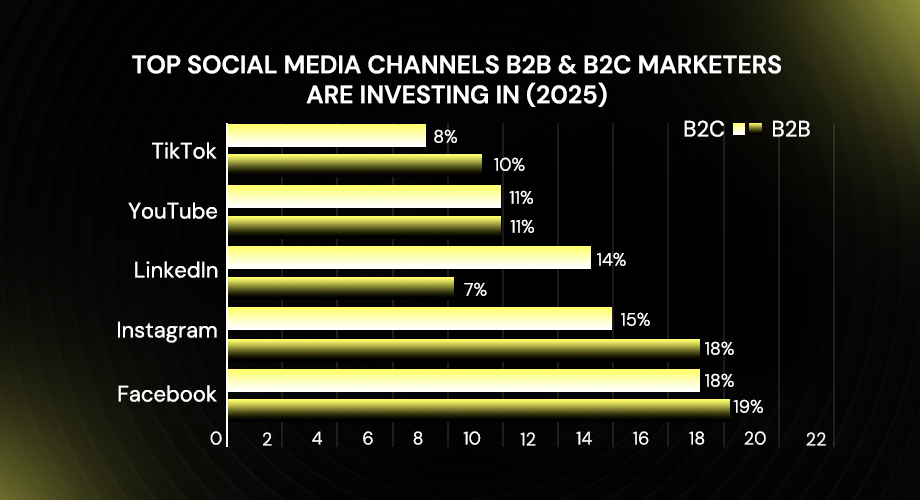
Source: HubSpot
The above report by HubSpot makes one thing obvious - social media isn’t slowing down anytime soon. In 2025, both B2B and B2C marketers are putting their money where the engagement is. Facebook and Instagram still top the charts, LinkedIn owns the B2B space, and YouTube keeps its loyal crowd. TikTok is stealing the spotlight, especially for B2C brands chasing younger audiences and short-form video gold.
Let’s be blunt. If you still treat social media like an afterthought, you’re leaving money on the table. Your audience doesn’t flip through magazines anymore. They scroll. They tap. They comment. They buy. The conversation about your brand is already happening with or without you.
Here’s why a social media campaign isn’t optional anymore.
Your customers spend hours on TikTok, Instagram, LinkedIn, Pinterest, or Facebook. They discover brands in between memes and recipes. You meet them by showing up where they already are.
Every platform lets you target like a laser. You can reach by age, city, interests, and even shopping habits. That’s social media advertising done right; it makes your ad budget actually mean something.
A social media marketing campaign lets your brand speak with people, not at them. When your followers comment, share, and tag, you stop being a faceless company and start being part of their day.
Billboards can’t tell you who looked. Ads on social can. You can track everything: clicks, conversions, costs. That’s modern performance marketing. It gives you control instead of guesswork.
It shows that social media marketing campaigns are VERY important. Social platforms have turned into the new front doors for visibility, engagement, and sales. It's because audiences spend more of their day online. They give brands the power to connect with people authentically, target the right audiences precisely, and shape real purchase decisions. Social media is the BIGGEST business growth machine.
So yes, the future is social. You can either be part of it or watch from the sidelines.
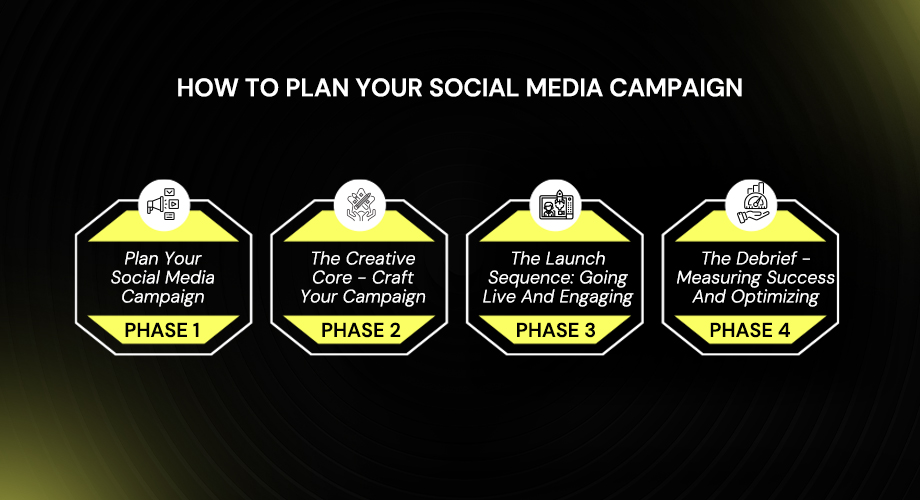
Here’s where it begins. Before a single post goes live, you need a plan that keeps you grounded when the algorithm changes its mood.
Think of this phase as laying the runway for your social media marketing campaign. No rush. Just smart groundwork.
Every great idea starts with a question: What do you actually want this campaign to do? “Go viral” doesn’t count. That’s luck. You need goals that make sense and can be tracked.
Try this S.M.A.R.T. approach now!
When you define goals this way, your social media marketing campaign has direction instead of chaos.
Now that your target’s clear, it’s time to find the people you’re speaking to. Because even the best message misses if it talks to the wrong crowd.
Picture this. You’re shouting into a crowded room. No one turns around. That’s what happens when you post without knowing who’s listening.
Get specific. What’s your audience’s routine? Their frustrations? Their sense of humor? What kind of videos do they binge at midnight?
Build a buyer persona, give them a name, a hobby, even a guilty pleasure show. When you can describe them like a friend, your social media campaign starts to click.
This clarity fuels effective social media campaigns because you stop guessing and start speaking directly to the people who care.
You know who they are. Now let’s decide where to meet them.
Here’s the trap: trying to be everywhere. You’ll end up exhausted and invisible.
Pick platforms that matter. Each has its own flavor:
| Platform | Best For | Audience Type |
| Community, local, broad | All ages | |
| Visual storytelling, e-commerce | Creative, younger | |
| TikTok | Trends, humor, short-form | Gen Z, fast-paced |
| B2B, thought leadership | Professional | |
| X | Real-time chatter | Conversational |
| Inspiration, ideas, products | Planning-driven |
Let your research decide. The best social media strategy focuses on where engagement already lives. Watch social media trends and stay flexible; today’s TikTok could be tomorrow’s ghost town.
You’ve picked your playground. Now, let’s talk about the resources that power the game.
Money doesn’t decide creativity, but it shapes the playground.
List your essentials:
You can start small, even 5 to 10 dollars a day on paid social media campaigns, which can teach you which levers to pull. Just test before scaling. When you assign every dollar a purpose, your social media ad campaign becomes lean, focused, and measurable.
The plan’s set, the audience defined, and the budget ready. Next comes the fun part, bringing the idea to life.
Now comes the part everyone looks forward to, the actual creation. You’ve done the prep work. The goals are clear, the audience is defined, and the budget is breathing comfortably.
This is where your social media marketing campaign starts to look and sound like something real.
It’s time to build the heart of your campaign, the part people will see, share, and remember.
Here’s where strategy meets creativity. The concept is the soul of your campaign. It’s the line that connects everything, from your first post to your final result.
Think of your concept as the one sentence that explains why anyone should care. It needs to be simple, clear, and magnetic.
Let’s look at a few timeless approaches:
These formats fuel effective social media campaigns because they give audiences something to engage with, not just something to scroll past.
Your big idea doesn’t have to shout. It just has to stick.
Now that your idea is alive, it’s time to build the structure that keeps your creativity consistent.
Here’s a simple truth: creativity without structure burns out fast. You don’t need random brilliance; you need repeatable rhythm. That’s where content pillars come in.
Think of them as the recurring themes your campaign stands on. They’re the categories that define your brand’s story. A great social media marketing campaign usually blends a few key pillars:
Tailor everything to the platform. What works on LinkedIn won’t behave the same on TikTok. Use relevant TikTok hashtags strategically, not just to trend, but to reach the right eyeballs.
Your social media campaign management should make every piece of content feel intentional. The mix of formats keeps your audience interested, while the consistency builds trust.
You’ve got the visuals and themes ready. Now let’s give your message a voice that actually makes people want to act.
Words sell the idea your visuals introduce. The right caption doesn’t sound like marketing; it sounds like a conversation your audience wants to have.
Here’s how to nail it:
Your captions should sound like you’re talking to one person, not shouting into the void. That’s how you make social media advertising campaigns feel personal.
A good copy isn’t about fancy words. It’s about clarity, rhythm, and timing. And when your words sync with your visuals, you create the best social media ads, the ones that feel like they belong in your feed, not an interruption to it.
The voice is set, the visuals are ready, and your concept is solid. Time to push the button and take your campaign live.
Here it is, the moment your campaign leaves the runway. All that planning and creative energy finally steps into the spotlight.
This phase is where your social media marketing campaign stops being a document on your drive and starts becoming a living, breathing experience for your audience.
You’ve built the engine; now it’s time to hit “go.”
Here’s the thing about consistency: it’s not glamorous, but it’s magic.
You can have stunning visuals, brilliant copy, and the best social media strategy, but if you post randomly, it all falls apart. The secret sauce? Structure.
Use social media campaign management tools like Buffer, Hootsuite, or Later to automate the posting process. These tools keep you on track, help you post at optimal times, and save you from last-minute panic posting.
Build a content calendar that maps everything: what to post, where to post, and when. That’s how smart social media advertising campaigns maintain rhythm.
If your audience knows when to expect you, they start to look forward to your content. That’s how the connection begins.
You’ve launched. Now it’s time to do what most brands forget: show up, stay present, and actually talk back.
You hit “publish.” Nice. But posting alone doesn’t build relationships; engagement does.
Think of your social media marketing campaign as a dinner party. You wouldn’t invite guests and then ignore them, right? You’d talk, laugh, and respond. That’s what engagement means.
Here’s your checklist for genuine connection:
Engagement doesn’t just please algorithms; it makes people feel seen. And when people feel seen, they come back.
That’s how you turn followers into fans and effective social media campaigns into actual communities.
You’ve got people talking. Now let’s turn that momentum into measurable growth.
Here’s where you step on the gas. Organic reach is great, but paid reach puts you in front of the people who haven’t discovered you yet.
Start with your best-performing organic posts. Boost them. They already have proof of concept, the audience liked them once; they’ll likely like them again.
Then, move to dedicated paid social media campaigns. Test everything, visuals, captions, CTAs, and even audience types. This A/B testing process reveals what clicks (literally).
That’s how you turn a simple social media ad campaign into a precision tool for growth.
This is performance marketing in real time. You don’t guess, you analyze. You don’t assume, you learn.
Once you know what works, you scale it. Rinse, repeat, grow.
The campaign is live, people are talking, the data is rolling in. Now comes the part that separates amateurs from pros: learning from what just happened.
Welcome to the phase most people skip, the one that decides whether your next campaign skyrockets or flatlines.
This is where your social media marketing campaign turns into data, and that data turns into insight. Think of this as your post-flight check. You’ve taken off, landed, and now you’re figuring out how to make the next trip smoother, faster, and smarter.
Here’s the rule: if you can’t measure it, you can’t improve it.
Remember those SMART goals you set earlier? This is where you bring them back to life. Your metrics need to connect directly to those goals.
Use this simple guide:
| Goal | Metrics to Track |
| Brand Awareness | Reach, Impressions, Video Views |
| Engagement | Likes, Comments, Shares, Saves |
| Website Traffic | Clicks, Click-Through Rate (CTR) |
| Lead Generation | Leads, Cost Per Lead (CPL) |
| Sales | Conversions, Return on Ad Spend (ROAS) |
Each platform, from Facebook Business Suite to TikTok Analytics, gives you a clear window into what’s happening. Don’t just glance at the numbers; study them.
They reveal which part of auditing your social media advertising campaigns delivered and which fizzled out. They tell you if your best social media ads were actually the best or just looked good.
The point isn’t perfection; it’s awareness. You can’t fix what you don’t understand.
Now that the numbers are in, let’s pull out the story they’re quietly trying to tell you.
Data without curiosity is just noise.
Ask yourself:
The answers tell you exactly how to refine your next social media marketing campaign.
And here’s a secret, the best marketers never stop experimenting. They live in constant beta mode, testing, tweaking, learning. Because social media evolution never pauses. Platforms change, algorithms shift, and trends vanish faster than your attention span during a long webinar.
So don’t chase trends blindly; adapt intentionally. Every campaign gives you clues for the next one. That’s the real best social media strategy: staying curious, nimble, and humble enough to keep learning.
You’ve gathered insights, learned lessons, and sharpened your instincts. Now, it’s time to see the bigger picture, where your story goes next.
You’ve done it. You’ve gone from strategy to storytelling, from analytics to action. That’s not just a social media marketing campaign; that’s a brand in motion. Your first campaign might not break the internet. It doesn’t have to. What matters is that it breaks inertia.
You now have a system that works:
Plan → Create → Launch → Measure → Learn
Every time you run that loop, you get better. Your targeting gets sharper. Your voice gets stronger. Your brand gets louder, in the right way. At its core, social media advertising isn’t about selling. It’s about connecting. It’s the art of showing up, saying something worth listening to, and saying it often enough that people start paying attention.
So here’s your call to action:
Keep showing up. Keep testing. Keep talking to your audience like they matter, because they do. The world of social media trends won’t slow down. But the brands that thrive are the ones that stay human, stay consistent, and stay curious. Your next great campaign isn’t waiting for inspiration. It’s waiting for action. Go create it.
Health & Med, a top e-commerce brand in the wellness industry, faced challenges in converting online engagement into actual patient appointments. Their previous social media advertising campaigns were too broad and lacked a targeted message. Content didn’t address specific patient concerns, and paid social media campaigns failed to generate qualified leads.
When they partnered with The Scale Performance, the team performed a detailed audit of their social media marketing campaign efforts. Several issues emerged: inconsistent branding across platforms, generic content that didn’t resonate with patients, and ineffective ad targeting.
The solution unfolded in three powerful phases:
1. Refined Audience Targeting:
We narrowed their audience to focus on specific demographics with high engagement potential. This reduced wasted ad spend by 37 percent and improved reach efficiency.
2. Content That Connects:
We developed personalized, condition-specific content addressing real patient questions and pain points. This approach created an effective social media campaign that doubled engagement within a month.
3. Streamlined Conversions:
We built a seamless user journey from social platforms to appointment booking. Every step was optimized, creating a frictionless experience that led to higher conversions.
The results spoke volumes:
These results show the power of well-executed social media ad campaigns. The 43% rise in leads proved that audience precision and storytelling create trust. The cost reduction showed that the best social media ads aren’t always about big budgets but about smart targeting and creative alignment.
This transformation highlighted one truth: combining a data-driven mindset with authentic messaging builds sustainable success in the age of social media evolution.
If you want viral social media campaigns, get in touch with our experts. From comprehensive audits and customized strategies to end-to-end social media campaign management, we help you design campaigns that connect and convert.
Need more clarity? Our FAQs cover everything you need to know about our process, services, and results.
Share with:


Get in touch today to see how we can help your business
achieve its full potential online.

The Scale Performance is a results-first ecommerce marketing agency helping brands scale fast with optimized campaigns and smart digital performance strategies.

Copyright © 2025 The Scale Performance. All rights reserved.