
On a stage in Long Beach, California, Snap CEO Evan Spiegel held up a pair of glasses and said something that should make every marketer pay attention: "Almost 20 years since the launch of the iPhone, people are ready to think about computing differently."
He's betting $2,195 of consumer trust on that sentence. Meta already placed its bet back in September, at less than half that price. And somewhere in the gap between those two numbers is the next major advertising surface most brands haven't started planning for yet.
This is one of those moments in marketing where the headline looks like a hardware story and the real story is somewhere else entirely. Two of the biggest social media platforms just spent years and untold engineering budgets building physical objects that sit on your face. Neither company did that because they love eyewear. They did it because whoever wins the glasses wins the next layer of attention, and attention is the only thing performance marketing has ever really been about.
Let's walk through what actually launched, how the two products compare, and then get into the part that matters most for anyone running paid media: what this means for where advertising goes next.
TL;DR
|
Snap's Specs, announced this week, are the company's first real attempt at consumer AR glasses since its original Spectacles flopped back in 2016. This time, the ambition is enormous. Specs are true see-through augmented reality glasses, built with two Qualcomm Snapdragon processors running side by side, one dedicated purely to computer vision, the other to rendering the AR experiences Snap calls Lenses. The display technology uses liquid crystal on silicon with a 51-degree field of view and 16 million colors, which Snap says gives wearers a display area roughly 30% larger than the previous developer-only generation.
They're light for what they pack in, somewhere around 132 to 136 grams depending on size, built from a Swiss polymer that Snap says makes them 40% lighter than their last AR glasses. Battery life sits at about four hours of mixed use, extending to twenty hours with the included charging case. There's hand tracking, gesture control, voice commands, and a contextual AI assistant that can answer questions about whatever you happen to be looking at in the moment.
Meta took a different path entirely. The Ray-Ban Display, which has been available since late September, costs $799 and comes paired with something called the Neural Band. This wristband reads tiny electrical signals in your wrist muscles to let you control the glasses with subtle finger movements, no hand-waving required. Rather than a full binocular AR display, Meta opted for a single screen in the right lens: a 600 by 600 pixel display offering a 20-degree field of view at a sharp 42 pixels per degree, refreshing at 90Hz. It's less of an immersive AR world and more of a heads-up display, think notifications, live translation captions, turn-by-turn directions, and now, following a software update this past May, things like Instagram Reels playback and customizable AR widgets layered right into your line of sight.
Meta's glasses run a bit heavier at 69 grams and offer between three and six hours of battery, depending on use, with the charging case stretching that to about a full day. They're already sitting in Best Buy, LensCrafters, Sunglass Hut, and Ray-Ban stores across the US, with expansion into Canada, France, Italy, and the UK rolling out this year.
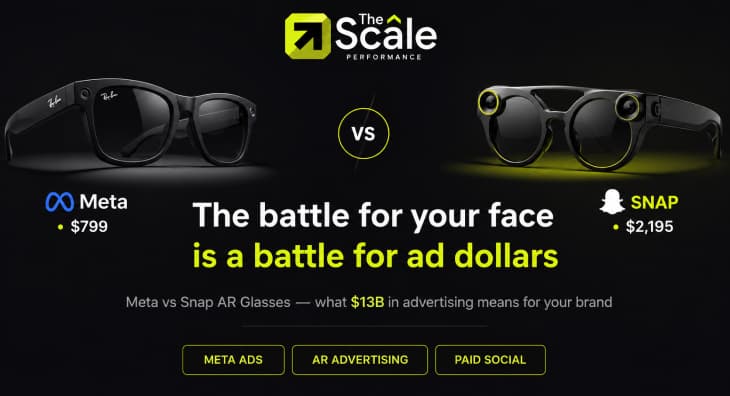
Put the two side by side, and the technical gap is obvious. Snap built something closer to true augmented reality: a wider, richer, more immersive visual layer over the real world. Meta built something closer to a smart notification layer with genuinely useful day-to-day utility, wrapped in a product people are already comfortable wearing because, frankly, it still looks like a normal pair of Ray-Bans. Here’s a simplified table:
| Features | Meta | Snap |
| Type | Ray-Ban Display | Specs |
| Price | $799 | $2,195 |
| Display | Single lens, 20° field of view | True AR, 51° field of view |
| Weight | 69g | 132-136g |
| Battery Life | 3-6 hrs (all day with case) | 4 hrs (20 hrs with case) |
| Control | Neural wristband | Hand tracking + gestures + voice |
| Best for | Notifications, Navigation, Reels | Immersive AR, Lenses, creation |
| Availability | Best Buy, Ray-Ban Stores | Pre-order now, ships fall 2026 |
| Helps | Everyday consumer | Creators & early adopters |
That difference in approach maps directly onto a difference in who each product is for. Spiegel has been candid about this: Snap's audience has always trended young, and that audience doesn't typically have $2,195 sitting around for an experimental wearable. Specs are clearly being positioned as an ecosystem bet for creators, developers, and early adopters who want to build the next layer of Snapchat experiences before anyone else gets there. Snap even opened up Lens Studio so developers can build with AI coding tools, treating Specs as much as a platform play as a product launch.
Meta, by contrast, priced the Ray-Ban Display to actually sell at scale, right alongside the everyday Ray-Ban Meta glasses that already proved people are willing to wear a camera and assistant on their face if it still looks like sunglasses. The May update: Reels integration, widgets, screen recording, wasn't really about adding gimmicks. It was Meta extending its existing content ecosystem onto a new screen, the same way it once extended Instagram from desktop to mobile.
Neither approach is wrong. They're just optimized for different timelines. Snap is building for where AR glasses might be in five years. Meta is trying to make today's version useful enough that people actually keep wearing them.
Here's the number that should be sitting in the back of every performance marketer's mind right now: industry forecasts put head-worn AR advertising revenue climbing from roughly $2.6 billion in 2024 to more than $13 billion by 2029. That's not a hypothetical market. That's a real, measurable curve, and it's climbing because both Meta and Snap are building the exact kind of first-party, attention-rich, context-aware surface that advertisers have wanted since the smartphone made everything else feel crowded.
Think about what becomes possible once enough people are wearing a screen that knows where they're looking and what's physically around them. A location-aware prompt that appears exactly when someone walks past a storefront. A live translation overlay sponsored by a travel brand, the moment someone needs it most. A gesture-based purchase flow that collapses the distance between seeing a product and buying it down to a flick of the wrist. These aren't far-off concepts. They're explicitly the use cases both companies are already building toward, and the advertising implications were part of the conversation the very week these products were unveiled.
For brands running paid social today, this should feel familiar. It's the same shift that happened when Instagram Stories became a primary ad surface, and the same shift that happened again when TikTok proved short-form vertical video could carry an entire advertising economy. Each time, the brands that started testing early, while the format still felt experimental and the competition was thin, ended up with a durable advantage once the platform matured and costs per impression climbed. The brands that waited for the format to feel "proven" arrived at a market that was already saturated and expensive.
AR glasses are sitting exactly where Stories sat in 2018, and TikTok sat in 2019. The audience is still small. The ad inventory is still mostly theoretical. And that's precisely the window worth paying attention to.
None of this means you need to rush out and build a Snap Lens or a Meta AR experience this quarter. The realistic first move is much simpler: start treating your existing social and search advertising the way you'll eventually need to treat AR advertising, because the skills transfer directly.
Location-aware targeting, contextual relevance, and instant micro-conversions are already core to what a well-run paid media program does on Meta and Google today. Brands that are sharpening those muscles now are building creatives that work in short, glanceable formats, structuring campaigns around real-time context rather than broad demographics, and getting comfortable with voice and gesture-triggered actions in their current ad experiences are quietly building the exact capability set that AR advertising will demand. When the inventory does open up at scale, probably starting with Meta, given its existing ad infrastructure and massive advertiser base already buying Instagram and Facebook placements, the brands ready to move fastest will be the ones who treated their current campaigns as a rehearsal.
It's also worth watching the platforms themselves closely over the next twelve months. Meta has every incentive to fold AR glasses into its existing Ads Manager once usage numbers justify it, which means advertisers already running Meta campaigns may get early access to glasses-specific placements before anyone else. Snap's path is less certain given its higher price point and smaller current user base, but its developer-first approach with AI coding tool integrations suggests the company is betting that early creative experimentation will pay off once Specs reach a wider audience later this year.
This is exactly the kind of shift our team tracks closely, because performance marketing has always rewarded the agencies and brands willing to move before a channel feels comfortable. We've watched this pattern play out across paid search, paid social, and short-form video, and the constant has always been the same: the brands that build foundational paid media discipline - sharp targeting, fast creative iteration, and a genuine read on where attention is migrating - are the ones positioned to capture a new surface the moment it opens up.
Right now, that means making sure your Meta and social advertising strategy is built on a foundation that can flex into whatever comes next, rather than one that's optimized purely for today's formats. Whether that's refining your Meta ad packages, tightening your PPC structure so budget can shift quickly when new inventory appears, or simply having a team that's already thinking about location-aware and context-aware creative, the work happening in your account today is the same work that prepares you for wearable advertising tomorrow.
The glasses themselves are still early. The advertising opportunity behind them is not. And the gap between those two timelines is exactly where a smart performance marketing strategy lives.
Need more clarity? Our FAQs cover everything you need to know about our process, services, and results.
Share with:


Get in touch today to see how we can help your business
achieve its full potential online.

The Scale Performance is a results-first ecommerce marketing agency helping brands scale fast with optimized campaigns and smart digital performance strategies.



Copyright © 2025 The Scale Performance. All rights reserved.