

| Competitive paid search helps your business appear in Google search results. This includes competitor research, choosing the right keywords, creating relevant ads, and optimizing your landing pages. By tracking competitors and continuously improving your campaigns, you can achieve better results and maximize their return on ad spend. |
Competitive paid search is a way of advertising on search engines. You pay a small fee only when someone clicks your ad. The word "competitive" is there for a reason. You are never bidding alone. You are up against other businesses for the very same clicks.
If you are new, do not worry. You don’t need a huge budget to do well. All you need is a clear plan and knowledge of your rivals. Specifically, you look closely at every competitor's pay-per-click campaign you can find. This study is called PPC competitor research.
TL;DR: Competitive Paid Search in 10 Seconds
|
Every time you search on Google, something happens in a split second. Google holds a tiny, hidden auction. It is over in less than a second. In that auction, Google decides which ads to show, and in what order. This is known as competitive paid search.
But the winner is not whoever pays the most. Google uses a scoring system called Ad Rank. There are 3 things that decide your score:
There is good news for beginners. A high Quality Score can beat a bigger bid. So a careful advertiser can win a top spot while paying less than a rival. That is why a smart competitive paid search PPC plan focuses on being useful, not just on spending more.
All of this runs on a PPC search engine like Google or Microsoft Bing. To win on one, you first need to understand the rivals who share it with you. That understanding comes from a simple paid search competitive analysis.
The businesses beating you in search may be ones you have never met. They could sit in another city and still take the clicks you wanted. This is why a proper competitive paid search audit is worth your time.
A competitor's analysis gives you three clear rewards.
PPC competitor research isn't about copying what others are doing. It's about learning what works and spotting opportunities they've missed. The better you understand your competitors, the smarter your campaigns become. This can improve targeting, reduce wasted spend, and maximize your ROI.
The brands outbidding you may be ones you have never considered. This is exactly why a proper competitive paid search audit pays off. A good competitor's analysis gives you three quick wins. You uncover market gaps your rivals have missed. You avoid the weak keywords they have already abandoned. And you plan a budget from real data instead of guesswork.
Follow these five steps to study your rivals in order:
Start by learning who is actually bidding against you. These businesses are your PPC competitors. They are not always the names you expect.
Google gives you a free report for this, called Auction Insights. You will find it inside your Google Ads account. It shows the other websites that appear in the same searches as you. The report uses a couple of terms such as:
Watch these numbers over the weeks. They are your core paid search metrics. When you read them with care, you learn exactly who your PPC competitors really are.
A keyword is simply a word or phrase that people type into search. Your rivals pay to appear for certain keywords. Your job is to find out which ones. Because when you learn their competitive paid search keywords, you often discover phrases you never thought to use.
Tools like SEMrush and Ahrefs can help you here. They let you type in a rival's website and then show you the words that rival pays for. This quickly reveals the competitors' PPC keywords you are missing.
You can also use a free option. Google Keyword Planner has a setting called "Start with a website." Paste your rival's web address there. Google will list the terms it links to their business.
One more tip. Watch for words your rivals stopped using. These are often poor performers. In advertising, we call these "negative keywords." They are words you tell Google to ignore. That way, your ad never shows for them, and you stop wasting money.
Building your own list of competitive paid search keywords this way is powerful. The competitors' PPC keywords you borrow can bring quick, cheap wins.
Next, look closely at the ads your rivals show. Reading their competitor PPC ads teaches you what pulls people in.
You do not need to click their ads. A click costs them money, but it also wastes your time. Instead, use free viewers.
The Google Ads Transparency Center is one. It shows every live ad a business is running. You can see their search ads, video ads, and image ads in one place.
The Meta Ad Library does the same for social media. It shows the ads a brand runs on Facebook and Instagram. Look at their images, their words, and their video openings.
As you study their competitor PPC ads, ask a few simple questions. What offer do they lead with? Is it a low price, free shipping, or fast service? And what do they ask you to do next? "Buy Now" points to a quick sale. "Get a Quote" points to a slower lead. Small patterns like these tell you a great deal.
An ad is only half the story. When someone clicks, they arrive on a page. That page is called a landing page. It is where the real selling happens.
So follow the click yourself. See where your rivals send people.
Check one thing first. Does the page keep the promise the ad made? If the ad says "half-price shoes," the page should show half-price shoes right away. When the message matches, people trust it and stay.
Then look at how easy the page is to use. Is the form short? Is the checkout simple? Does the page load fast? Every extra step or delay makes people leave.
Finally, note their offers. Do they give a free trial? A first-order discount? A free guide in exchange for an email? These hooks show you how they turn a visitor into a customer. If you run an online store, PPC Management for ecommerce can help you create product-focused campaigns, optimize shopping ads, and turn more clicks into sales.
The last step is about money and timing. You want to know when your rivals spend the most.
Some tools estimate how much a business spends on ads each month. They are not perfect, but they reveal trends. Watch for spikes. A jump in a rival's competitor pay per click spending often lines up with a busy season, like a holiday sale.
You can also filter this data by country or region. This shows how the cost of a click changes from place to place. In a big city, clicks often cost more. Knowing this helps you decide where to compete.
You can beat richer rivals even as a beginner. You do not have to outspend them. You just have to be more useful than them. This is where competitive paid search is truly won.
Start with relevance. Match your ad's words to what people actually search for. If someone types "cheap running shoes for men," your ad should mention exactly that. A rival with a vague, general ad will lose to your exact match. And Google will charge you less for the click.
Next, use your ad extensions. Remember, those are the extra links and details under your ad. They make your ad bigger and more helpful. A bigger ad earns more clicks than a plain one.
Last, fix your landing page. Make it load fast. Make it work well on a phone. Make sure it delivers what the ad promised. When the page works well, more visitors become buyers. That means you earn more from every dollar you spend.
Want to take your campaigns beyond competitor research? Learn PPC Advertising Strategies, proven techniques for building, managing, and optimizing campaigns that deliver better ROI.
You will hear two terms often. Here is a table to show what each one means.
| Bidding idea | What it means | What to keep in mind |
| Conquesting | Bidding on a rival's brand name, so your ad shows up when people search for your competitor | It is bold, and it works. But rivals can do the same to you, so keep an eye on your own brand name |
| Automated bidding | Letting Google set the bid for each search based on a goal you choose, like a target cost per sale | Google raises your bids when a shopper looks ready to buy, and lowers them when they do not |
Here is the explanation:
The first is "conquesting." This means bidding on a rival's brand name. So when someone searches for your competitor, your ad appears too. It is bold, and it works. Just know that rivals may do the same to you, so keep an eye on your own brand name.
The second is "automated bidding". Setting the right bid for every single search by hand is impossible. So Google can do it for you. You give it a goal, like a target cost per sale. Google then adjusts your bids in real time. It raises them when a shopper looks ready to buy, and lowers them when they do not.
Whichever you use, keep checking your results. Good paid search analytics simply means looking at your numbers often. It tells you whether a change helped or hurt. Want to save even more time while improving campaign performance? Learn how PPC automation uses AI, smart bidding, and automated rules to optimize your campaigns with less manual work.
You do not have to gather all of this by hand. A few tools do the heavy lifting for competitive paid search. Many of them are free. Every major PPC search engine also gives you built-in reports to start with.
Here are the main ones worth knowing, side by side:
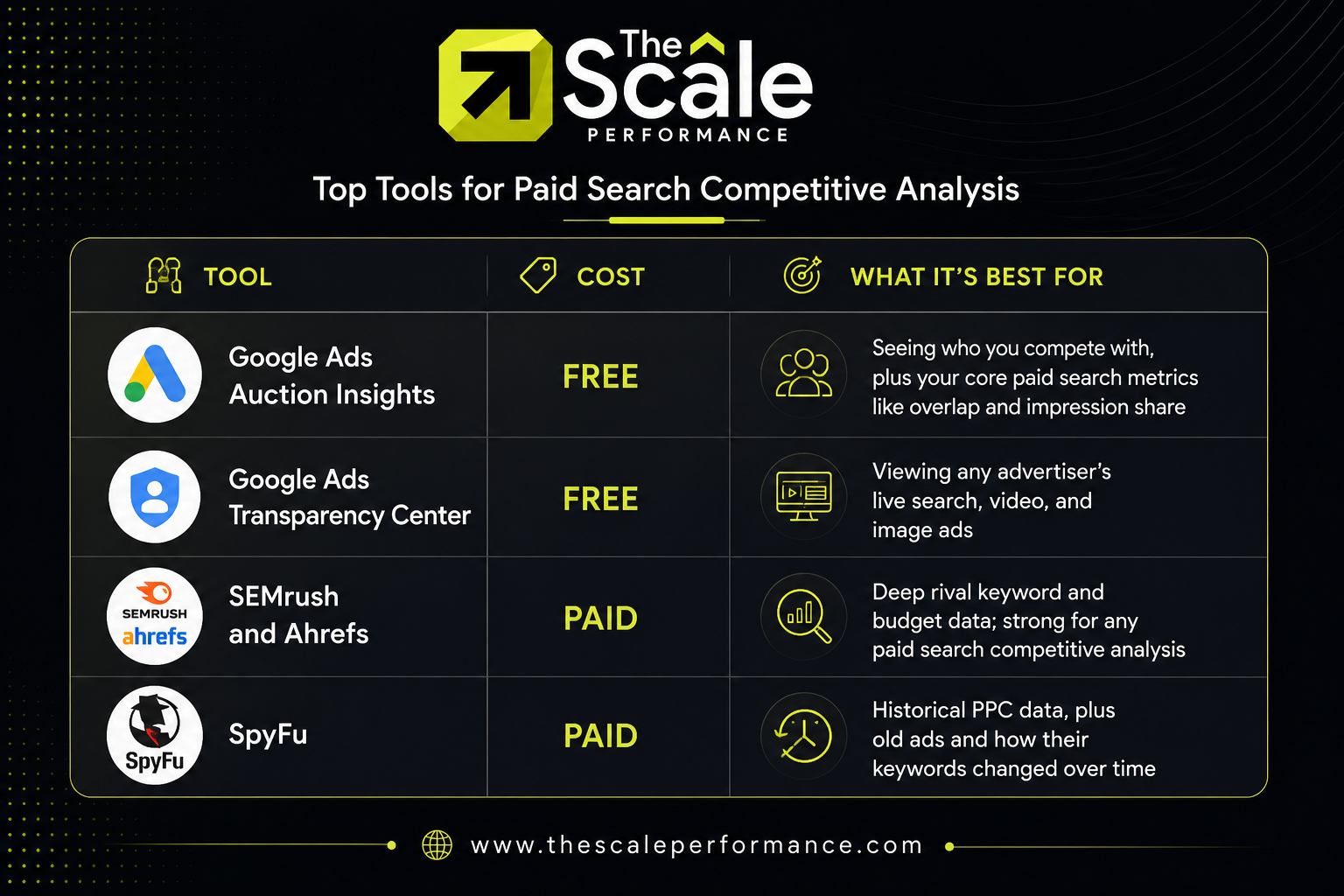
Pick one or two to begin. Your paid search analytics will get sharper with every check. Over time, a single competitive paid search audit turns into a steady habit.
Competitive paid search rewards the advertiser who learns the most, not the one who spends the most. When you know your rivals well, you win better spots for less.
So start small and stay curious. Run one simple competitor analysis this week. Check your own PPC analysis against a single rival. Then improve from there.
A steady competitive paid search PPC habit, built on real data, is how a nervous beginner grows into a confident advertiser. Learn the process once, and competitive paid search stops feeling scary. It becomes a game you know how to play.
Running this research well takes time and steady attention. Many small business owners simply do not have those spare hours. That is where an expert can help. The Scale Performance, USA’s leading performance marketing agency, works on paid ad research.
Our PPC Management Team handles keyword research, competitor analysis, audience targeting, bid optimization, and ongoing campaign improvements. We focus on driving qualified traffic, increasing conversions, and maximizing your return on ad spend. Take the first step toward better advertising now.
Need more clarity? Our FAQs cover everything you need to know about our process, services, and results.
Share with:


Get in touch today to see how we can help your business
achieve its full potential online.

The Scale Performance is a results-first ecommerce marketing agency helping brands scale fast with optimized campaigns and smart digital performance strategies.



Copyright © 2025 The Scale Performance. All rights reserved.