
| Conversion funnel optimization means you improve the steps people take from the first click to the final action, so they finish the action you want. You look for where most people leave, fix what’s confusing or slow, and make the path clearer with stronger CTAs and simpler forms. Then you test changes (like A/B tests) to keep boosting conversions over time. |
If you’ve ever looked at your analytics and thought, “Where are people disappearing?” you’re already thinking like a funnel optimizer. Conversion funnel optimization shows you what’s breaking in your funnel and how to repair it step by step, so conversions rise without needing more traffic.
This guide walks you through conversion funnel optimization from scratch: stages, metrics, tools, best practices, and real fixes you can apply to boost conversions without chasing more traffic.
If you’ve ever looked at your analytics and thought, “Why aren’t more people buying?” you’re already standing inside your funnel, you just haven’t mapped it yet. That frustration is exactly what conversion funnel optimization solves.
A conversion funnel is simply the journey your audience takes from first discovering you to finally taking action. Those are your conversion funnel stages:
Awareness → Interest → Consideration → Conversion → Retention.
At each stage, some people naturally drop off. That’s normal. Your goal is to reduce unnecessary drop-offs and guide the right people forward. That’s the core of conversion funnel marketing. So if your funnel ever feels “mysterious,” don’t worry, you’re not missing a secret trick. You’re just one solid map away from making conversion funnel optimization feel clear and controllable.
You don’t need more visitors as badly as you think. You need more of your current visitors to say yes. That shift in mindset is where conversion funnel optimization starts paying you back.
When you improve your funnel conversion rates, every marketing channel gets stronger. A small lift at one stage improves your entire sales funnel conversion rate. This is also why paid traffic can feel expensive until you fix the funnel because PPC campaigns, pay-per-click (PPC) traffic, and social advertising only work well when your funnel works well. That’s modern performance marketing in one sentence.
If you want growth that feels less stressful and more predictable, this is your path. Conversion funnel optimization is how you build a funnel that actually earns its keep.
You’ve probably heard both terms thrown around like they mean the same thing. And honestly, if you’re building campaigns or improving pages, it can feel confusing fast. But once you see the difference clearly, your strategy gets way sharper, and your funnel decisions start making more sense.
Here’s a clear table that breaks it down side-by-side:
| Aspect | Conversion Funnel | Customer Journey |
| Core focus | Your business goal and the steps to get a conversion | Your customer’s real experience with your brand |
| What it represents | A designed path you create to drive an action | A lived path people actually take in real life |
| Direction | Mostly linear and stage-based | Often non-linear, emotional, and messy |
| Main question it answers | “How do you get more people to convert?” | “How do people experience and decide around your brand?” |
| Structure | Fixed stages like Awareness → Conversion | Flexible touchpoints across time |
| What you measure | Drop-offs, stage conversion rates, funnel metrics | Emotions, needs, motivations, satisfaction, loyalty |
| Time span | Usually short-term until conversion | Covers before, during, and long after conversion |
| Includes post-purchase? | Not always (often ends at conversion) | Yes, retention and loyalty are core parts |
| How you use it | To improve conversion funnel optimization and sales results | To improve the overall experience and long-term relationship |
| Typical tools | Funnel reports, CRO tests, analytics, heatmaps | Journey maps, interviews, surveys, CX insights |
| Success looks like | Higher funnel conversion rates and sales funnel conversion rate | Better trust, satisfaction, repeat buying, advocacy |
| Biggest risk if ignored | You lose conversions because of friction/leaks | You lose customers because the experience feels disconnected |
So here’s the takeaway you can keep in your pocket: your funnel is what you want people to do, and the customer journey is what they’re actually experiencing. When you design funnels that fit real journeys, conversions stop feeling like a battle and start feeling like a natural next step.
If you’ve ever felt like these three terms get used interchangeably, you’re not imagining it. One blog says “marketing funnel,” another says “sales funnel,” and your analytics tool calls it a “conversion funnel.” So what are you actually supposed to build and optimize? Once you separate them clearly, your strategy stops feeling fuzzy and starts feeling structured.
Let’s break it down in the simplest, most real-world way.
| Funnel Type | Primary Purpose | Where It Operates Most | Typical End Goal |
| Marketing funnel | Generate awareness and interest | Ads, content, social, email, SEO | A qualified lead or prospect |
| Sales funnel | Convert prospects into customers | Calls, demos, proposals, checkout | Purchase or signed deal |
| Conversion funnel | Improve the completion of any key action | Any stage with a measurable conversion | Higher conversion rate for that action |
So next time someone says “funnel,” you’ll know exactly what they mean and, more importantly, what you should do with it. Marketing funnels bring people closer, sales funnels help them commit, and conversion funnels help you optimize every step so fewer good prospects slip away.
You know that feeling when you try fixing something, but nothing changes? That’s what happens when you optimize blindly. You deserve clearer targets before you start tweaking pages.
Start with conversion funnel analysis:
This gives you a clean conversion rate optimization funnel blueprint, and it makes your funnel optimization strategies practical instead of random. Once you see your funnel on one page, everything gets easier. Your next conversion funnel optimization move will feel obvious.
If you want more conversions without chasing more traffic, you need conversion rate optimization best practices that make decisions easier for your visitors. That’s what conversion rate optimization is really about, understanding where people hesitate, why they drop off, and what small changes help them move forward. The best part? You don’t need a massive redesign. You just need smart, proven CRO moves that turn your existing funnel into a smoother, higher-converting path.
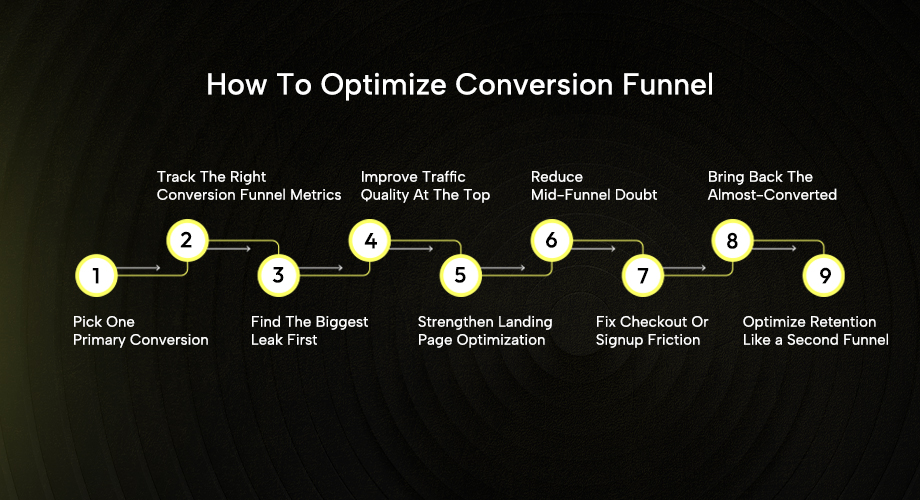
If your funnel feels messy, it’s usually because your goal is messy. You can’t optimize five outcomes at once and expect clarity.
Choose one main action per funnel: buy, book a call, start a trial, or request a demo. This single focus sharpens your conversion funnel optimization work instantly.
One goal = one direction. And direction is what keeps your funnel upgrades clean and profitable.
Data shouldn’t overwhelm you. It should guide you. The right conversion funnel metrics don’t just show what happened, they show where to fix.
Track:
These conversion funnel metrics help you spot leaks. When you know your numbers, you stop reacting emotionally and start improving strategically. That’s real conversion funnel optimization.
Your funnel has many weak spots, but only one urgent weak spot. Fixing the largest leak first gives you the fastest win.
Use conversion funnel analysis stage by stage. Prioritize the biggest drop-off. This simple rule is one of the smartest funnel optimization strategies you can follow.
You don’t need 20 changes. You need one right change at a time. That’s how conversion funnel optimization compounds.
If the wrong people enter your funnel, even a perfect page won’t convert them. That’s why top-of-funnel quality comes first.
Fix this by tightening:
High-intent traffic boosts funnel conversion rates before anyone even scrolls. Bring in the right people first, and every step in the conversion funnel optimization gets easier.
Your landing page decides whether curiosity turns into action or into a bounce. That’s why landing page optimization is such a high-leverage win.
Your landing page should answer in seconds:
Clear headlines, social proof, lean forms, and strong CTAs make landing page optimization lift funnel conversion rates and improve your sales funnel conversion rate. When your landing page feels effortless to say yes to, conversion funnel optimization starts paying you back fast.
People don’t drop mid-funnel because they hate your offer. They drop because they’re unsure. Your job is to guide that uncertainty.
Use conversion rate optimization strategies like:
These conversion rate optimization strategies keep people moving through the funnel stages and raise your overall performance. If your mid-funnel feels warmer and more confident, conversions rise naturally, without you “pushing” anyone.
You’ve already earned their attention. Don’t lose the sale because the last step is annoying.
Apply conversion rate optimization best practices:
This stage is where conversion funnel optimization often creates the biggest revenue jump. Make the final “yes” easy, and your funnel rewards you daily.
Not everyone converts on the first visit, and that’s fine. Your funnel should account for human timing.
Retarget with:
This is core funnel optimization and a strong part of your conversion funnel marketing. Your job isn’t to force a fast yes. Your job is to stay relevant until they’re ready.
Your easiest conversions are the repeat ones. Retention is where profit quietly multiplies. Improve onboarding, milestone triggers, education flows, and referrals. This strengthens your full conversion rate optimization funnel, boosts lifetime value, and supports long-term performance marketing.
If you want growth that feels stable, don’t stop after purchase; extend conversion funnel optimization into loyalty.
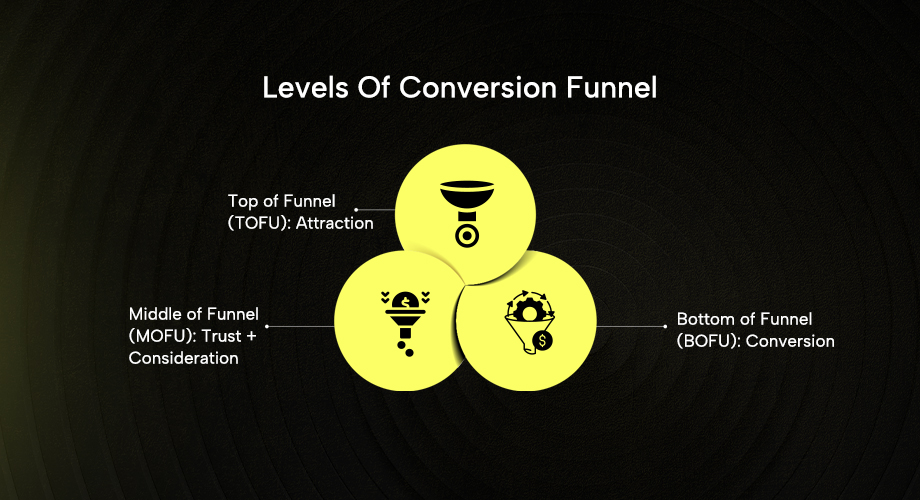
If your funnel feels overwhelming, zoom out for a second. Every conversion funnel, no matter how complex, boils down to three simple levels. When you see these clearly, you always know where to optimize next.
This is where people first find you. Your goal here is to pull in the right audience through content, SEO, PPC campaigns / pay-per-click (PPC), and social advertising.
This is where people compare, evaluate, and decide if they trust you. Your goal is to educate, reduce doubt, and prove value using demos, case studies, emails, and retargeting.
This is where people take action. Your goal is to remove friction and make the final “yes” easy through strong pricing pages, checkout flows, and clear CTAs.
That’s it- three levels. If you keep asking, “Which level is leaking most right now?” your next funnel move becomes obvious every single time.
You can pour time, money, and energy into getting clicks, but if people don’t move forward after they land, all that effort stalls. A conversion funnel is what turns your marketing from “busy” into “profitable.”
A conversion funnel is important because it gives you:
When your funnel is clear, your funnel conversion rates rise naturally, your sales funnel conversion rate improves, and your entire growth system becomes easier to scale. So if growth ever feels unpredictable, your funnel is the missing structure. Build it, track it, optimize it, and you’ll feel your marketing start pulling results instead of just pulling effort.
You don’t need a huge tech stack to optimize your funnel; you just need conversion rate optimization tools that show where people drop and why they drop. Think simple, sharp, and action-oriented.
The 3 conversion funnel optimization tools you actually need are:
Start with GA4 to find the biggest drop-off, use Hotjar or Clarity to understand the cause, then run A/B tests in VWO to lock in the win. That simple combo covers almost every conversion funnel optimization need without overwhelming you.
When you’re deep in growth work, it’s easy to jump into random tweaks. This conversion rate optimization checklist keeps you grounded. Use it weekly or bi-weekly, and you’ll always know what to fix next instead of guessing.
Run this checklist consistently, and your funnel stops feeling chaotic. You’ll always have a next step, a clear priority, and a steady path to better conversions without burning out your team or budget. This keeps your conversion rate optimization steady, and it keeps your funnel optimization aligned to reality. Follow that rhythm, and optimizing your conversion funnel becomes a habit.
If you’re staring at dashboards and still wondering why conversions aren’t rising, you’re not alone. The fix isn’t “more data.” The fix is tracking the right funnel numbers, so you instantly see where people fall out and what to improve first.
Here are the metrics that matter most, without the fluff.
This is the percentage of people who move from one stage to the next. It’s the backbone of conversion funnel analysis. It tells you exactly which stage is weak.
The drop-off rate shows how many people leave at each step instead of progressing. A high drop-off spot = your biggest leak and your first optimization target.
This tracks how long people take to move through your funnel. Long delays signal confusion, hesitation, or friction in that stage.
How many visitors turn into leads (signup, form fill, trial, etc.). If this is low, your targeting or landing page isn’t matching intent.
How many leads finally become paying customers? This shows if your middle/bottom funnel is building enough trust.
How much do you spend to get one customer? Even decent conversion rates fail if the acquisition cost is too high.
How much revenue does one customer generate over time? A funnel isn’t just about first purchase; it’s about profitable retention.
If you keep your focus on these seven metrics, your funnel stops being a mystery. You’ll always know where the leak is, what to fix first, and whether your changes are actually improving conversions.
Even when you know your funnel matters, optimizing it can feel like trying to solve a puzzle with missing pieces. You see the drop-offs, you try fixes, and sometimes… nothing moves. That’s normal. Funnel work is powerful, but it comes with a few common challenges. The good news? Every one of them has a clean way out.
Here are the biggest challenges you’ll face and exactly how to beat them.
Your dashboard is full, but your decisions are empty. That’s when you need to focus on stage conversion rate, drop-off rate, and time to convert first. Pick one bottleneck, not five. Build a simple weekly view of your funnel, not a data jungle.
Analytics shows where the leak is, but not what caused it. Use heatmaps and session replays to watch real behavior. Add micro-surveys like “What stopped you today?” on key pages. Look for patterns: confusion, hesitation, trust gaps, or UX friction.
Lots of visits, weak funnel conversion rates. Tighten audience intent in SEO, PPC campaigns, and social advertising. Match the ad promise to the landing page message. Cut low-quality segments fast instead of “hoping they convert later.”
You’re not sure what to test first, so you test nothing. Break your funnel into the 3 levels (TOFU, MOFU, BOFU). Optimize only the largest leak in one level at a time. Keep a short test backlog and rank by potential impact.
You change the copy or design, but the results don’t improve. But you can overcome it. Write hypotheses like this: “If you change X, the Y metric will improve because Z behavior is blocking users.” That’s how you turn random tweaks into real conversion experiments.
You know what to fix, but execution is slow. Start with low-dev tests: headline, CTA, layout, proof placement. Use lightweight landing page tools for quick variants. If needed, bring in CRO experts or a conversion rate optimization agency to speed up testing.
Conversions rise, but revenue doesn’t grow as much as expected. Treat onboarding and repeat purchase like a second funnel. Track activation and retention metrics. Improve post-purchase experience to lift lifetime value, not just first conversion.
You don’t need a perfect funnel; you need a progressively better one. Every challenge above is just a signpost telling you where to focus next. Stay consistent, fix one leak at a time, and conversion funnel optimization stops feeling hard… and starts feeling like the easiest growth lever you have.
You’ve already seen that conversion funnel optimization is about removing leaks between steps. This case study is a perfect real-world example of what happens when the top of your funnel gets optimized properly first because if TOFU doesn’t grow, nothing downstream gets a chance to convert.
What Happened in the Case Study (Quick Snapshot)
In this campaign, X5 Power’s social performance climbed sharply in just 10 weeks. The study shows:
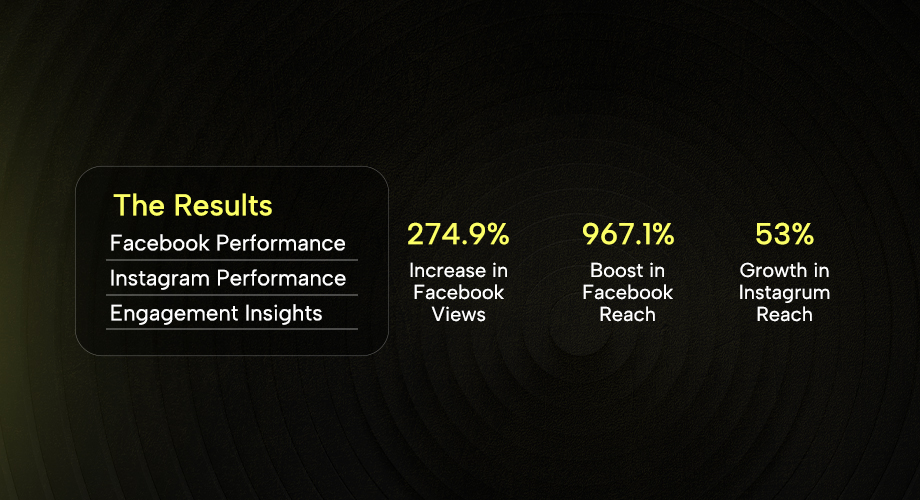
In simple terms, visibility and engagement skyrocketed because the content and distribution were optimized to pull more people into the brand ecosystem.
This result is a textbook TOFU win. More reach and views mean more qualified people entering your funnel. When your top-of-funnel expands like this, your next funnel stages (landing pages, lead capture, nurturing, sales) automatically get more opportunities to convert.
Think of it like this:
This is why conversion funnel optimization always starts with the biggest leak or gap. In this case, the gap was reach and visibility, so optimizing content strategy and distribution fixed the top-of-funnel bottleneck first.
If your business is stuck, the problem might not be your offer or your sales page. It might be that your funnel isn’t getting enough right-fit people at the top. This case study proves that once TOFU performance is optimized, your entire conversion system has room to grow. So when you look at your own funnel, ask yourself: “Is the top strong enough to feed the rest?” If not, start there because a smoother, wider entry point is often the fastest way to unlock better conversions across every stage.
Conversion funnel optimization isn’t about getting louder, it’s about getting smoother. When you map your funnel, track the right metrics, fix the biggest drop-offs, and test improvements, more of your existing traffic turns into real results. The case study showed the same truth: once the top of the funnel was strengthened, everything downstream had a better chance to convert.
So if your business feels stuck in a similar way: traffic coming in, but conversions not moving, you don’t have to solve it alone. Connect with us, and you’ll get CRO experts providing the best conversion rate optimization services and a clear path to higher conversions.
Need more clarity? Our FAQs cover everything you need to know about our process, services, and results.
Share with:


Get in touch today to see how we can help your business
achieve its full potential online.

The Scale Performance is a results-first ecommerce marketing agency helping brands scale fast with optimized campaigns and smart digital performance strategies.


Copyright © 2025 The Scale Performance. All rights reserved.